Repository navigation
Adding Opentelemetry to MCP SDK #421

Description

Is your feature request related to a problem? Please describe.
I would like to see Opentelemetry traces and Metrics baked into SDK.
E.g.
- Traces emitted on all Requests from client and server side of MCP SDK.
- Metrics for tool/prompt/resource calls
Describe the solution you'd like
I am trying to use Opentelemetry sdk to add traces and metrics features.
Steps
- Creating session in client and server.
- Initialise tracer (Opentelemetry tracer instances) in
BaseSession(src/mcp/shared/session.py). - Binding trace context (
traceparent) to_metaofRequestParams.Metabefore sending request from client (send_requestinsrc/mcp/shared/session.py) - In server use the
traceparentfrom received request to create new span with incoming span as parent span.
Describe alternatives you've considered
I tried to implement the same via traceloop. I was not able to get correct parent - child relationship between spans while doing so.
Additional context
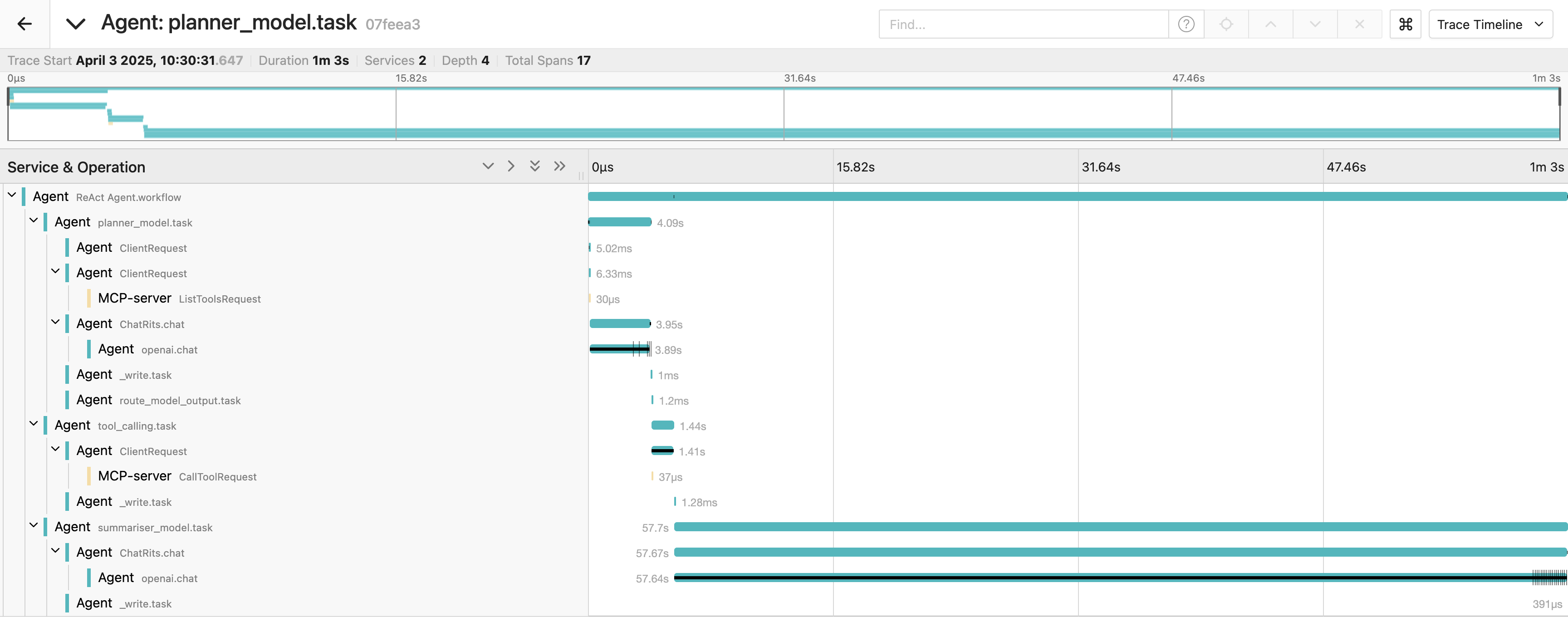
I am able to achieve distributed tracing across my Agentic application and MCP server.
Reacted by Jake Gaylor, wenxuwan, Ronen Schaffer, Tom Plant, Guangya Liu, Sam Spencer, Chanwoo Noh, Dan Miller, debu99, hughsimpson and 3 more
Activity
hk-bmi commentedon Apr 3, 2025
related Issue for feature request in traceloop/openllmetry to enable observability for MCP Server, traceloop/openllmetry#2662
wenxuwan commentedon Apr 7, 2025
I'm now trying to inject a tracer for each request by defining the SofaTracerMiddleware(which inherits BaseHTTPMiddleware) and accessing the above plugin for the mcp server application via add_middleware.
But I found that the requests about message used the same tracer from the initialise method with url messages, and the subsequent initialize and tools methods didn't use the new tracer
wenxuwan commentedon Apr 8, 2025
It is also clear from the logs that the ContextVarsScope used for opentracing each time a request is processed is that of the first request, even though handle_post_message and SofaTracerMiddleware use the latest ContextVarsScope for each request.
So now do I have a way to get my own async ContextVarsScope for each request?
fali007 commentedon Apr 8, 2025
Hi @wenxuwan,
I tried your approach and I don't think it will work because if you choose http header to propagate trace context, only the initialize request has http header. That's why you see the same parent for all subsequent requests as well.
I was tinkering with the traceloop way of passing context by intercepting and wrapping over
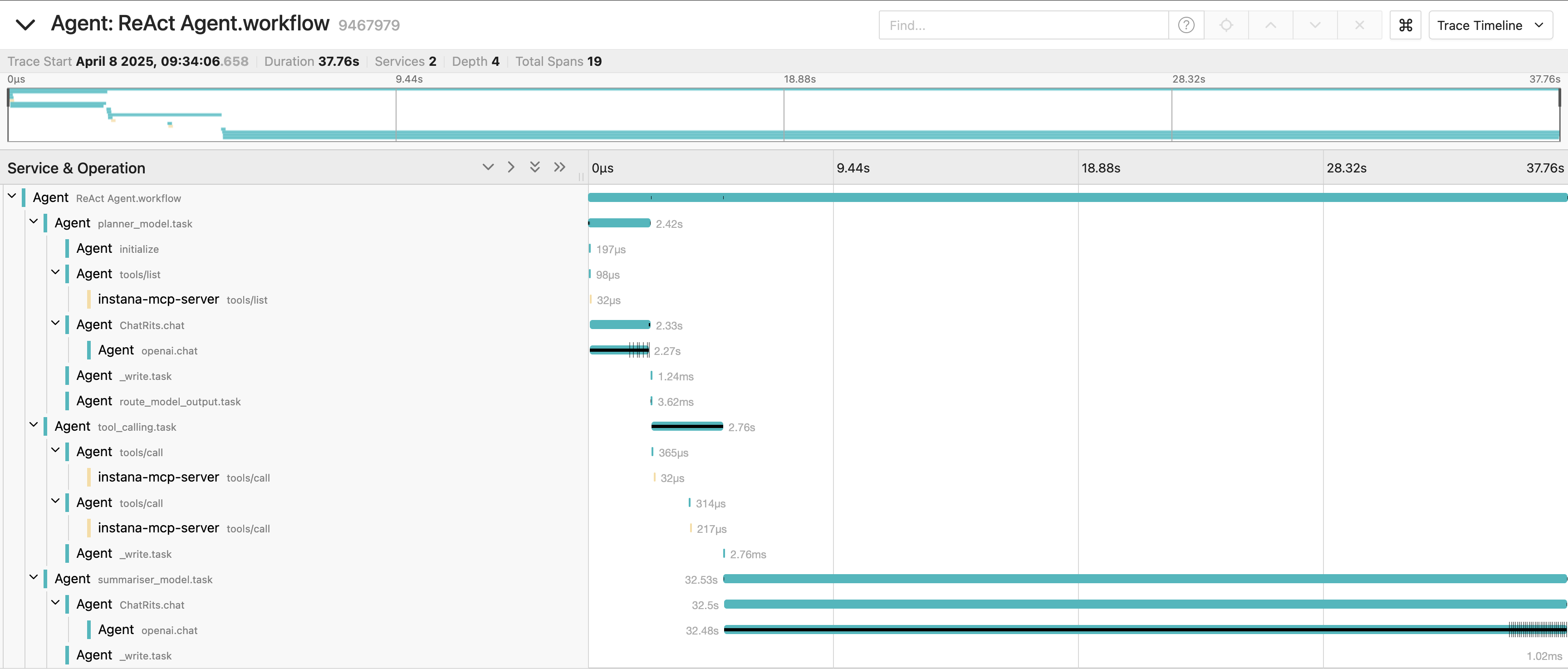
_handle_requestfunction inmcp.server.lowlevel.server.pyfor server side andsend_requestfunction inmcp.shared.session.pyfor client side tracing. I am trying to passtraceparentinparams.meta.traceparentof theRequestParamsfromtypes.py.I am able to map correct parent - child span relationship.
Screenshot shows how the context is propagated from Agent application to MCP servers back and forth. Here parent - child span ID is correct.
wenxuwan commentedon Apr 8, 2025
You are right, but not quite the same as my problem. Right now I'm not passing the tracer inside my http request. every time I make a request
The new contextVar is generated inside the current async, but now only one async has been processing the user's request, so the tracer is the Contextvar of the first request. That's why handle_post_message gets the newest tracer every time, but when processing the request is using the tracer of the first request.
samsp-msft commentedon Apr 28, 2025
Adding some links:
modelcontextprotocol/modelcontextprotocol#246 - request to add tracing to MCP spec
modelcontextprotocol/modelcontextprotocol#414 - fix for the spec to use
params._metafor trace context propagation such asparams._meta.traceparentopen-telemetry/semantic-conventions#2083 - semantic convention proposal for MCP traces and metrics.
codefromthecrypt commentedon May 1, 2025
for the context propagation part, you can have a look at @anuraaga's code in openinference or if such a change is welcome maybe he can help raise it. I don't know the SDK specific policies about an otel dependency, but as python is flexible with imports maybe it is fine to just add it directly?
alexmojaki commentedon Oct 6, 2025
Workaround for the problem of ContextVars being lost in the async streams preventing other forms of context propagation from working: pydantic/logfire#1459
5 remaining items
anuraaga commentedon Nov 28, 2025
Noticed this since happen to be mentioned here a long time ago but not a maintainer. But as a general instrumenter, want to note that API can't work unless
Generally I'd recommend the latter. Langchain was stuck for going with the former with no return value. Now I can't open this link for whatever reason.
https://github.com/langchain-ai/langchain/discussions/27954
refactor: use token-based instrumentation API for OpenTelemetry support
DylanRussell commentedon Dec 10, 2025
OTel python uses a
ContextVarto propagate the trace/span context. AContextVaris supposed to be a per-thread and per-task variable.. Is the issue that the MCP library just uses 1 task per-connection instead of per-request, so we get the ContextVars from when the connection started ?Or is it possibly due to where the task is getting it's context from ? According to this a
anyio.Taskgets it's context from theanyio.Taskthat call's it'sstartmethod..With
asyncio.Taskyou can explicitly pass aContext..aabmass commentedon Jan 13, 2026
I have a pretty minimal fix to propagate contextvars through the anyio streams by attaching a
contextvars.ContexttoSessionMessageand restoring it in the worker tasks main...aabmass:mcp-python-sdk:propagate-contextvars.I'm happy to add more tests send a full PR if maintainers are onboard with this approach. The change is completely independent of OTel and would also benefit other users of contextvars.
dgenio commentedon Feb 28, 2026
Hi — I opened PR #1693 a while back with a pluggable instrumentation interface (token-based API) to address this issue. That PR is now stale due to significant refactoring in the codebase (
_handle_request,ServerRequestContext, task support, etc.).I noticed this issue is assigned to @Kludex — are you already planning or working on an approach for this? I'm happy to:
Just want to avoid duplicating work. Let me know how you'd like to proceed.
feat: implement mcp.server.operation.duration and mcp.server.session.…
verdie-g commentedon Apr 5, 2026
I'm proposing an implementation for the server metrics in #2394
MukundaKatta commentedon May 10, 2026
Strong agree on baking OTel in. The minimum useful spans are server-side request_handler (with tool/prompt/resource type as an attribute), client-side outgoing tool_call, and a transport-layer parent that links sessions to spans across the SSE/streamable-http boundary.
Worth using the gen_ai semantic conventions for tool spans (gen_ai.tool.name, gen_ai.tool.call.id) so existing OTel collectors can correlate MCP traffic with the LLM call that triggered it. OpenInference's semconv overlaps but isn't the standardized one.
Happy to draft a proposal if there's appetite.
Kakarottoooo commentedon Jun 5, 2026
I’m interested in taking a narrow, non-overlapping slice of #421.
I noticed #2093 is already working on trace-context propagation through
_meta, so I would avoid duplicating that work.A smaller first PR I can take:
Would maintainers prefer this as:
main/ v2, orI’m happy to keep the first PR minimal and aligned with the existing v2 direction.
Necmttn commentedon Jun 21, 2026
The minimum stable API should make OTel mapping possible without making OTel the dependency.
I would expose request/tool/resource lifecycle events with a fake-recorder test suite: send_request, handle_request, tool_call, resource_read, prompt_get, success, and error. Each event should carry session id, request id, method, tool/resource name, and traceparent metadata when present.
Separately, context propagation through anyio/contextvars needs a regression test. If context disappears across the task boundary, every higher-level span design becomes hard to reason about.
Generated with ax.
dgenio commentedon Jun 22, 2026
This is close to the direction I was exploring in #1693.
One detail I’d keep explicit in the API shape: lifecycle hooks need either to return a token/state from
startand receive it again onend/error, or be modeled as a wrapper around the handled operation. Otherwise OTel span lifetime has to be tracked through side storage, which gets fragile once async/task boundaries are involved.I also agree that a fake-recorder test suite is the right first layer. It lets the SDK define stable lifecycle semantics without committing to OpenTelemetry as a hard dependency, while a separate adapter can map those events to OTel spans/metrics.
And +1 on the contextvars/anyio regression test being a prerequisite. If context disappears across the stream/task boundary, every higher-level instrumenter becomes harder to reason about.
HarperZ9 commentedon Jun 29, 2026
I added a public synthetic fixture for the lifecycle-hook shape discussed here, mainly to make the fake-recorder requirement concrete without forcing OpenTelemetry as a hard dependency.
The case is mcp_lifecycle_fake_recorder: send_request -> handle_request -> tool_call -> tool_result -> span_end, all joined by the same request id. The tool result explicitly carries mcp_is_error: true and
esult_state: failed, so an implementation can prove that a failed MCP result does not become a successful span or persisted result by accident. The fixture also asserts that span lifetime needs a token/state that can survive async boundaries.
Fixture: https://github.com/HarperZ9/telos/blob/e12425b/demo/integrations/agent-boundary-fixtures.json
Verifier: https://github.com/HarperZ9/telos/blob/e12425b/demo/agent-boundary-fixtures.test.mjs
This is not a conformance claim against the SDK; it is just a small receipt-shaped test corpus that might help keep the first instrumentation API narrow and fake-recorder-testable.
maxisbey commentedon Jul 25, 2026
Hey everyone! As this issue has gotten quite long and open telemetry has been added into the v2 beta version of
mcpI think it'd be best to go ahead and close this issue for now.I'd super appreciate if people go ahead and test the open telemetry integration we currently have, and then make new issues for feedback/suggestions/issues you run into going forward.
More info here: https://py.sdk.modelcontextprotocol.io/v2/run/opentelemetry/